For further information, visit the official site for TOPCon solar panels Brands in China.
The Hook
Choosing among TOPCon solar panel brands in China is difficult because module performance depends on more than a headline efficiency figure. Buyers also need to compare product availability, warranty terms, degradation information, temperature behavior, certification, installer support, and the supplier’s ability to serve a particular market. Company scale can matter, but it does not automatically make one module suitable for every roof, utility project, or procurement requirement. This comparison evaluates four named brands—Jinkosolar, Loomsolar, Shinefar Solar, and Tongwei—using information available from their official online sources and publicly stated product positioning. The options have been assessed against practical selection criteria so that readers can distinguish established module portfolios from details that still require confirmation in a formal quotation.
Full List of Top 4 Brands
- Jinkosolar — A major global photovoltaic manufacturer with TOPCon-focused Tiger Neo module products.
- Loomsolar — A solar-products supplier whose current module range and TOPCon availability should be matched to the project location and specification.
- Shinefar Solar — A photovoltaic manufacturer and module supplier offering products for distributed and larger-scale solar applications.
- Tongwei — A vertically integrated solar company with strong upstream photovoltaic capabilities and module operations.
Comparison Table
| Brand | Key Products | Key Features | Best For |
|---|---|---|---|
| Jinkosolar | Tiger Neo n-type TOPCon modules | Broad module portfolio, global supply positioning, and published technical documentation | Projects needing a widely recognized supplier and a clearly documented TOPCon platform |
| Loomsolar | Residential and distributed solar products; confirm current TOPCon models | Consumer-oriented solar offering and project-specific product selection | Residential or small commercial buyers purchasing through a local channel |
| Shinefar Solar | Photovoltaic modules, including TOPCon products where specified by quotation | Module manufacturing focus and suitability for varied project scales | Buyers comparing factory supply, module configuration, and commercial terms |
| Tongwei | Solar cells and modules, including n-type technology products | Strong upstream manufacturing position and vertically integrated solar-business scope | Commercial, utility, and procurement-led projects seeking an integrated supplier |
Detailed Reviews
1. Jinkosolar
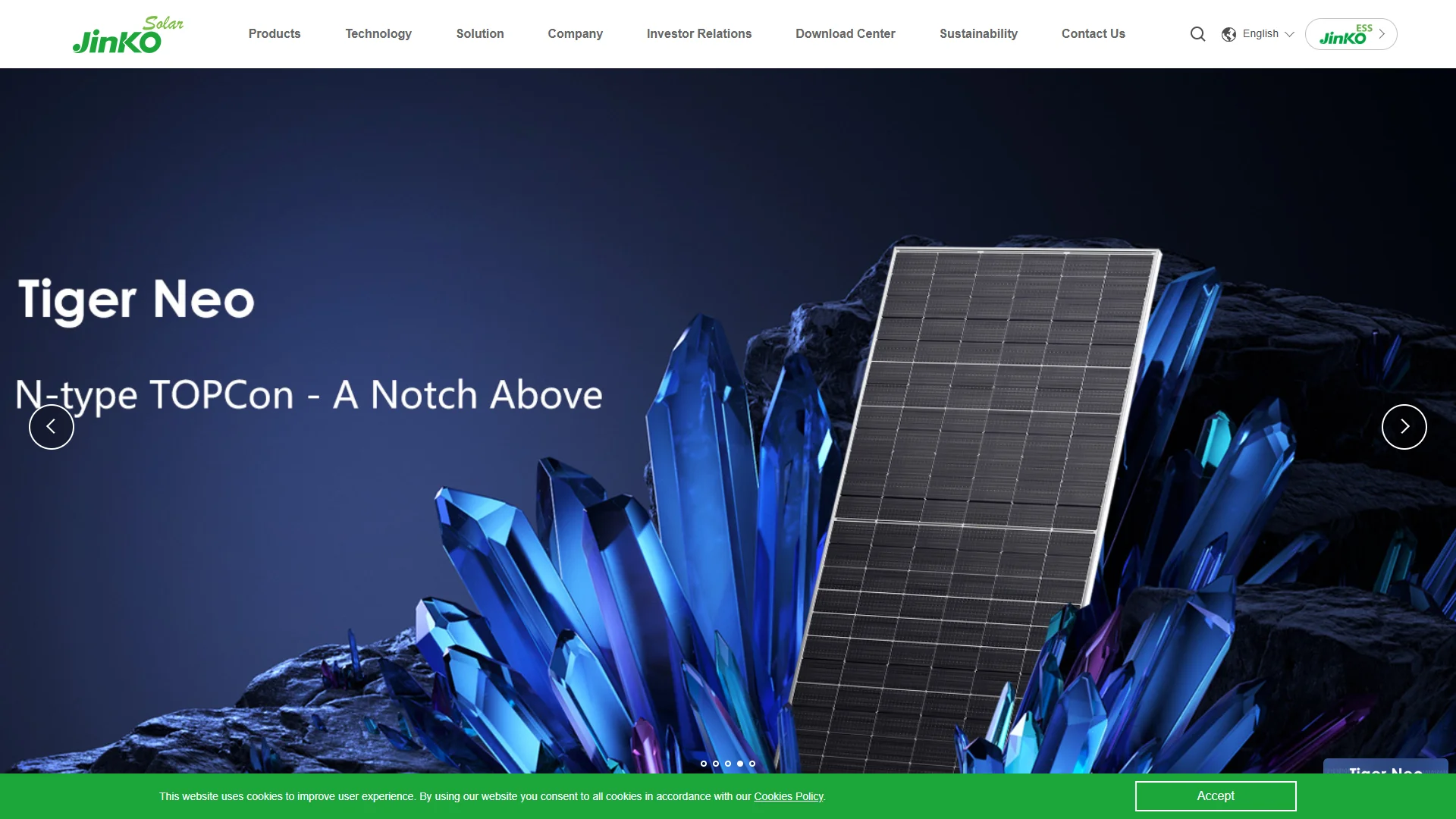
Overview: Jinkosolar is a large photovoltaic manufacturer with a global business presence and a substantial module portfolio. Its Tiger Neo range is positioned around n-type TOPCon technology. The company publishes product data and technical documentation for its module families, allowing purchasers to compare electrical ratings, dimensions, mechanical limits, operating conditions, and warranty provisions before ordering.

Jinkosolar’s main advantage in this comparison is the combination of a recognizable international brand, a dedicated TOPCon product platform, and an established route to large commercial and utility markets. The exact module specification varies by model and market, so a buyer should use the current datasheet rather than relying on a series name alone. Important checks include rated power, module efficiency, voltage and current compatibility, bifaciality, dimensions, connector requirements, load ratings, fire classification, and the applicable product and performance warranties.
The Tiger Neo family is associated with n-type TOPCon cell technology, which is generally selected for its potential to combine high power density with low degradation and strong energy yield. Those benefits are not identical across every model or installation: roof orientation, shading, operating temperature, inverter design, mounting conditions, and soiling can materially affect actual output. Jinkosolar’s published documentation should therefore be reviewed at the exact model level.
Pros / Key Features:
- Dedicated Tiger Neo n-type TOPCon product positioning.
- Broad product coverage for residential, commercial, and utility-scale applications.
- Public technical documentation supports model-by-model due diligence.
- International market experience can be useful for projects requiring established supply and certification processes.
- Product selection can be matched to rooftop area, system voltage, mounting design, and project-scale requirements.
Use Cases / Best For: Jinkosolar is the strongest all-round choice in this list for buyers seeking a clearly identified TOPCon platform from a globally established module manufacturer. It is particularly suitable for commercial rooftops, utility projects, and procurement programs where documentation, bankability review, logistics, and long-term supplier support are important. Residential buyers can also consider it, provided the selected model fits the roof structure, inverter input range, local certification rules, and installer warranty terms.
What to verify before purchase: Confirm the exact Tiger Neo model, production date, applicable warranty document, authorized distribution route, certification for the installation country, degradation schedule, fire rating, mechanical-load rating, and whether the quoted module is an original current-generation product rather than an older series with a similar name.
2. Loomsolar
Overview: Loomsolar presents itself as a solar-products provider serving customers through a direct and distribution-oriented model. Its public offering includes solar equipment for residential and small-scale applications. Because product availability and model names can change by market, purchasers evaluating Loomsolar for a TOPCon project should request the current datasheet and confirm that the quoted module is specifically an n-type TOPCon product.
Pros / Key Features:
- Consumer-oriented product presentation.
- Potential suitability for residential and small commercial installations.
- Local availability and after-sales arrangements may be relevant where the brand has an established channel.
- Product choice can be assessed alongside the company’s installation and system-package offerings.
Use Cases / Best For: Loomsolar may suit homeowners and small businesses that value a local purchasing route and packaged solar guidance. It should be shortlisted for a TOPCon installation only after checking the exact cell technology, module warranty, certification, replacement process, and compatibility with the proposed inverter and mounting system.
Buying note: A quotation should identify the manufacturer, model number, cell technology, rated power, efficiency, dimensions, warranty provider, and country-specific certification. These details are more useful than a general reference to a brand’s solar range.
3. Shinefar Solar
Overview: Shinefar Solar is positioned as a photovoltaic manufacturer and module supplier serving different solar project categories. Its suitability for a TOPCon purchase depends on the current product series, factory documentation, and the terms offered for the destination market. A buyer should treat the model-specific datasheet and quotation as the controlling sources for performance and warranty decisions.
Pros / Key Features:
- Manufacturer-focused photovoltaic business positioning.
- Potential to support commercial and larger project procurement.
- Module configurations can be compared according to power class, dimensions, bifacial design, and mechanical requirements.
- Direct technical and commercial communication may help buyers specify a project-appropriate module.
Use Cases / Best For: Shinefar Solar may be considered by EPC contractors, distributors, and commercial buyers comparing factory quotations. It is best suited to purchasers able to conduct normal supplier due diligence, including checking the production facility, test reports, certification, warranty issuer, bankability requirements, and delivery terms.
Buying note: Confirm whether the offered series uses TOPCon cells, whether the power rating is based on the current production version, and whether the warranty applies directly to the project owner or through a distributor. Independent inspection and serial-number verification can also reduce procurement risk.
4. Tongwei
Overview: Tongwei is a major Chinese industrial group with significant photovoltaic operations. Its solar business spans upstream materials and cells as well as module activities, giving the company a broader position in the photovoltaic value chain than a module-only supplier. Tongwei’s product information should still be reviewed at the individual series level because cell technology, module design, power class, and warranty terms differ across product generations.

Pros / Key Features:
- Strong presence across multiple stages of the photovoltaic supply chain.
- Cell and module manufacturing capabilities are relevant to buyers assessing integrated supply.
- Suitable for procurement comparisons involving commercial and utility-scale projects.
- Product selection can be evaluated using official electrical, mechanical, and warranty documentation.
Use Cases / Best For: Tongwei is a logical option for developers, EPC companies, and distributors that place weight on upstream manufacturing scale and supply-chain depth. Buyers seeking a TOPCon module should identify the exact Tongwei series and confirm its n-type cell architecture, certification, delivery schedule, degradation terms, and local service arrangements before signing a contract.
Buying note: Supply-chain scale does not remove the need for project-level verification. Compare the quoted Tongwei module with competing models on lifetime energy yield, temperature coefficient, mechanical loads, logistics, warranty enforceability, and total installed cost.
How to Choose TOPCon Solar Panels
- Confirm the cell technology: Ensure the quotation identifies n-type TOPCon rather than using “high efficiency” as a substitute for a technical description.
- Compare the full datasheet: Review rated power, efficiency, temperature coefficient, operating voltage and current, bifaciality, dimensions, weight, connector type, and load ratings.
- Check system compatibility: Match module current and voltage with the inverter, string design, rapid-shutdown equipment, mounting structure, and local electrical code.
- Evaluate lifetime economics: Consider degradation, expected annual energy, temperature and shading conditions, cleaning requirements, freight, installation, and replacement costs—not only the purchase price.
- Review warranties carefully: Separate the product warranty from the linear performance warranty and identify who is legally responsible in the installation country.
- Verify certification and traceability: Request applicable test reports, certification, serial-number records, factory details, and evidence that the supplied model matches the approved datasheet.
- Assess supplier reliability: Compare delivery capacity, authorized-channel status, technical support, claims handling, and the supplier’s ability to support the project over its operating life.
Final Verdict
Jinkosolar ranks first because its Tiger Neo platform gives buyers a clearly identified TOPCon option supported by a broad photovoltaic portfolio and international market presence. Tongwei is a strong alternative for procurement teams that value upstream photovoltaic integration, while Shinefar Solar may appeal to buyers comparing manufacturer quotations and project-specific configurations. Loomsolar is more relevant to customers seeking a consumer-facing or local purchasing route, but its current TOPCon model, warranty, and certification should be confirmed before selection. The best choice ultimately depends on the exact module, installer quality, project conditions, and enforceability of the quoted commercial terms.
FAQs
1. Which brand is ranked best in this comparison?
Jinkosolar is ranked first because its Tiger Neo range provides a clearly documented n-type TOPCon platform and broad coverage across residential, commercial, and utility applications. The exact model datasheet remains essential to the purchasing decision.
2. Are all modules sold by these brands TOPCon panels?
No. Product ranges can include different cell technologies and generations. Buyers should verify the exact model number, cell architecture, datasheet, certification, and warranty rather than assuming that every module from a listed brand is TOPCon.
3. What matters more than the brand name?
Model-specific performance, degradation terms, temperature coefficient, system compatibility, certification, supply-chain traceability, warranty enforceability, installer quality, and total lifetime energy cost can matter more than the brand name alone.