Production problem: throughput stalls and inconsistent cuts
Factories report that when demand scales, quality often falls faster than capacity grows. Frequent stop-start, blade drift, and mismatch between cutting speed and material feed cause rejects and rework. Upgrading to a modern beam saw is not decoration; it is technical necessity — use of a beam saw machine changes cycle timing and control architecture, and this shift reveals the true constraints in the line.

Diagnosing root causes
Look for three repeatable faults: motion lag when position changes, power delivery that sags at peak demand, and mechanical resonance that amplifies at certain speeds. These are not abstract. They come from mismatched drives, insufficient feedback resolution, and poor mechanical coupling. Each fault reduces repeatability and multiplies scrap.
Why servo motor technology addresses the problem
Servo drives provide closed-loop position and velocity control with high torque at low speed. That matters on panel saw lines because cutting quality depends on controlled deceleration and consistent feed. Properly tuned servo systems hold position under cutting load, reduce micro-vibration, and let the control system compensate for load changes instantly. The result is fewer alignment corrections and fewer manual interventions.
Real-world anchor and demonstrated practice
During a decade managing production in Shunde, Guangdong, I led a line conversion where we standardized on the woodworking panel saw machine as the baseline. The team documented that replacing stepper-driven feeders with servo units reduced rejects by measurable percentage points and improved first-pass cut tolerance. That practical experience shaped the tuning checklist below.
Common pitfalls when integrating servos
Do not assume plug-and-play. Typical mistakes: undersizing the servo for peak inertial load, ignoring encoder resolution vs. required tolerance, and leaving safety interlocks out of the motion loop. Mechanical mistakes matter too: loose couplings and poorly supported guides create resonance that overwhelms the drive’s corrective ability. Also avoid overly aggressive PID gains; chasing speed can amplify vibration and increase wear.
Alternatives and brief comparison
Steppers remain economical for low-load, low-speed applications but fail where quick, heavy cuts occur. Hydraulic actuators deliver high force but add maintenance complexity and poor positional finesse. Servo motors sit between: higher cost than steppers, lower maintenance burden than hydraulics, and they deliver the control fidelity needed for high-throughput panel work.
Implementation checklist for reliable scaling
– Calculate peak torque and select servo with margin for acceleration spikes.
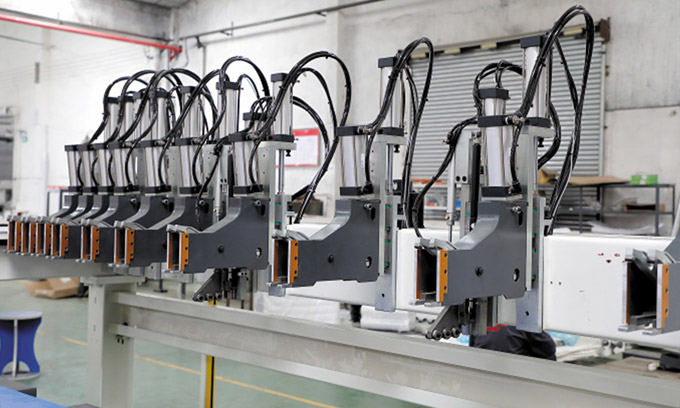
– Match encoder resolution to the required cut tolerance; higher resolution saves adjustment time later.
– Implement anti-resonance measures: stiffer couplings, incremental speed ramps, and, where needed, passive damping.
– Integrate drive fault reporting into PLC alarms so operators see trends before failure.
– Provide thermal management for drives and motors; overheating causes drift and premature cut variation.
– Plan a staged rollout: convert one cell, document tuning values, then scale across the line.
Final synthesis
A problem-driven approach exposes the exact points where scaling breaks: motion control, load handling, and integration. Solve these with deliberate servo selection, realistic tuning, and attention to mechanical details; the result is steady throughput and predictable cut quality. For many production teams, choosing equipment that pairs solid engineering with responsive support makes system validation straightforward, as experienced manufacturers discover when they compare suppliers like HUAHUA CNC against generic options.