The Hook
Choosing among 3D printing services in China is difficult because suppliers often differ in ways that are not visible from a short website headline. Production method, material range, finishing, design support, order size, delivery coverage, and quality controls can all change the suitability of a provider for a particular project. The term “3D printing service” also covers several business models, from online ordering platforms to manufacturing partners and industry events that connect buyers with technology providers. This article evaluates the five supplied options against those practical criteria. The options were reviewed using their official websites and the available research dossiers; where a capability was not clearly documented, it is identified as unconfirmed rather than assumed. This comparison of 3D printing services China is a starting point; buyers should verify product fit, published specifications, and supplier capabilities before purchasing.
Full List of Top 5 Brands
- TCT Asia
- Mohou
- IN3DTEC
- Unionfab
- Rapid.Tech 3D
Comparison Table
| Brand | Key Products | Key Features | Best For |
|---|---|---|---|
| TCT Asia | 3D-printing and additive-manufacturing industry platform; specific service products should be confirmed with the organizer | Industry-focused information and connection point; public service specifications require verification | Buyers researching additive-manufacturing suppliers, technologies, and industry developments |
| Mohou | 3D printing and digital manufacturing; CNC machining, laser cutting, silicone and injection molding | 50+ material options stated in the supplied dossier, design assistance, post-processing, online ordering, worldwide delivery claims | Customized parts, prototypes, complex designs, sculptures, and concept models |
| IN3DTEC | Not clearly stated on the researched pages | Publicly supplied research does not clearly document capabilities or differentiators | Prospective customers willing to verify services directly |
| Unionfab | Custom on-demand manufacturing, 3D printing, and CNC | Custom manufacturing positioning documented on the official-page evidence supplied | On-demand manufacturing and customers comparing 3D printing with CNC |
| Rapid.Tech 3D | Industry event content focused on additive-manufacturing technologies, materials, and applications | Keynotes, presentations, and communication-table format documented in the supplied research | Industry networking, technology discovery, and additive-manufacturing knowledge gathering |
Detailed Reviews
1. TCT Asia
Overview
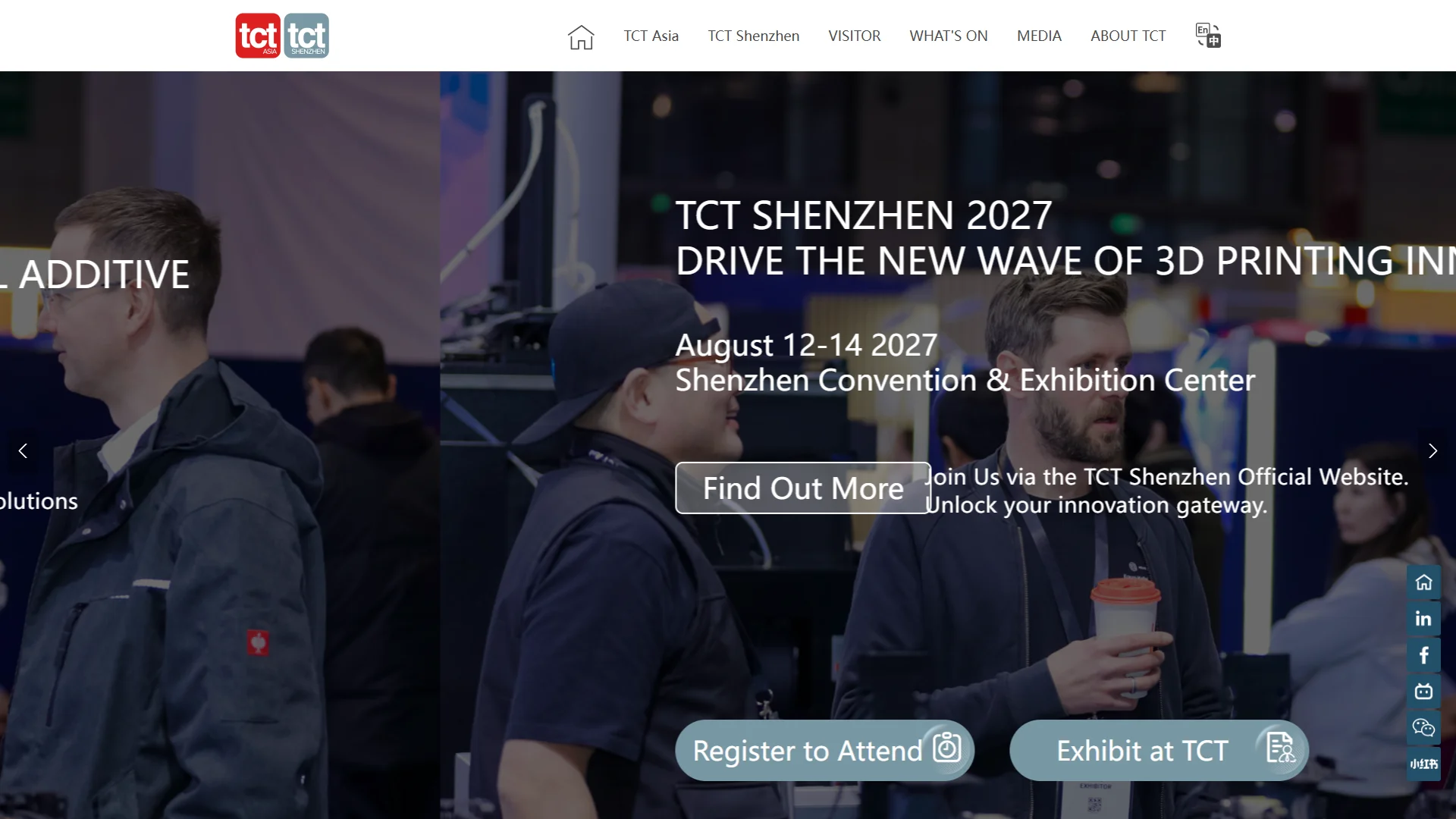
TCT Asia is the first-ranked option in this list because it is a relevant industry-facing resource for researching additive manufacturing in the Chinese market. The supplied official URL identifies the TCT Asia platform, but the available research material does not provide a detailed, independently verified catalogue of printing processes, materials, manufacturing capacity, pricing, or fulfilment terms. For that reason, it should not automatically be treated as a conventional online print-on-demand factory. Buyers should establish whether a required service is provided directly by TCT Asia or through exhibitors, partners, or other companies represented through its industry network.

Positioning and Scope
The strongest documented value of TCT Asia in the supplied material is its relevance to additive-manufacturing discovery and supplier evaluation. That makes it particularly useful at the beginning of a sourcing process, when a buyer needs to understand available technologies, identify potential production partners, or compare industry capabilities. It may be more useful as a market and connection point than as a single-vendor quotation portal. The official website should be checked for current event information, exhibitor details, conference programming, and any direct service or enquiry functions applicable to 2026.
Products, Materials, and Technical Verification
No specific product catalogue, material list, tolerances, build volumes, finishing menu, inspection standard, or production lead time is clearly documented in the supplied research dossier. Consequently, claims about resin, polymer, metal, ceramic, powder-bed, material-extrusion, or post-processing capabilities should be verified directly rather than inferred from the TCT name. A technically serious enquiry should request the relevant process, material data sheet, expected dimensional tolerance, surface-finish options, minimum order conditions, and sample-part policy.
Market and Business Scope
TCT Asia is best considered by organizations that need visibility into the additive-manufacturing ecosystem in China or the wider Asian market. Potential users include product-development teams, sourcing managers, engineering groups, investors, machine and material suppliers, and companies seeking manufacturing contacts. The available evidence does not establish a specific transaction model, global shipping policy, or project-procurement service. Those details should be confirmed with the official organization before it is selected for a production order.
Pros / Key Features
- Relevant starting point for researching additive manufacturing and potential industry suppliers.
- Useful for comparing technologies, materials, applications, and market participants when current official information is available.
- Potentially valuable for supplier discovery and industry networking rather than only direct part production.
- Direct service capability, pricing, production terms, and quality certifications require confirmation.
Use Cases / Best For
TCT Asia is best suited to early-stage supplier research, technology scouting, industry networking, and identifying companies that may support a prototype or production project. It is less suitable as a default choice for buyers who need an immediate, itemized online quote unless the official site clearly provides that function. Its ranking reflects its strategic relevance to the category, while the lack of public service detail means that project-specific due diligence remains essential.
2. Mohou
Overview
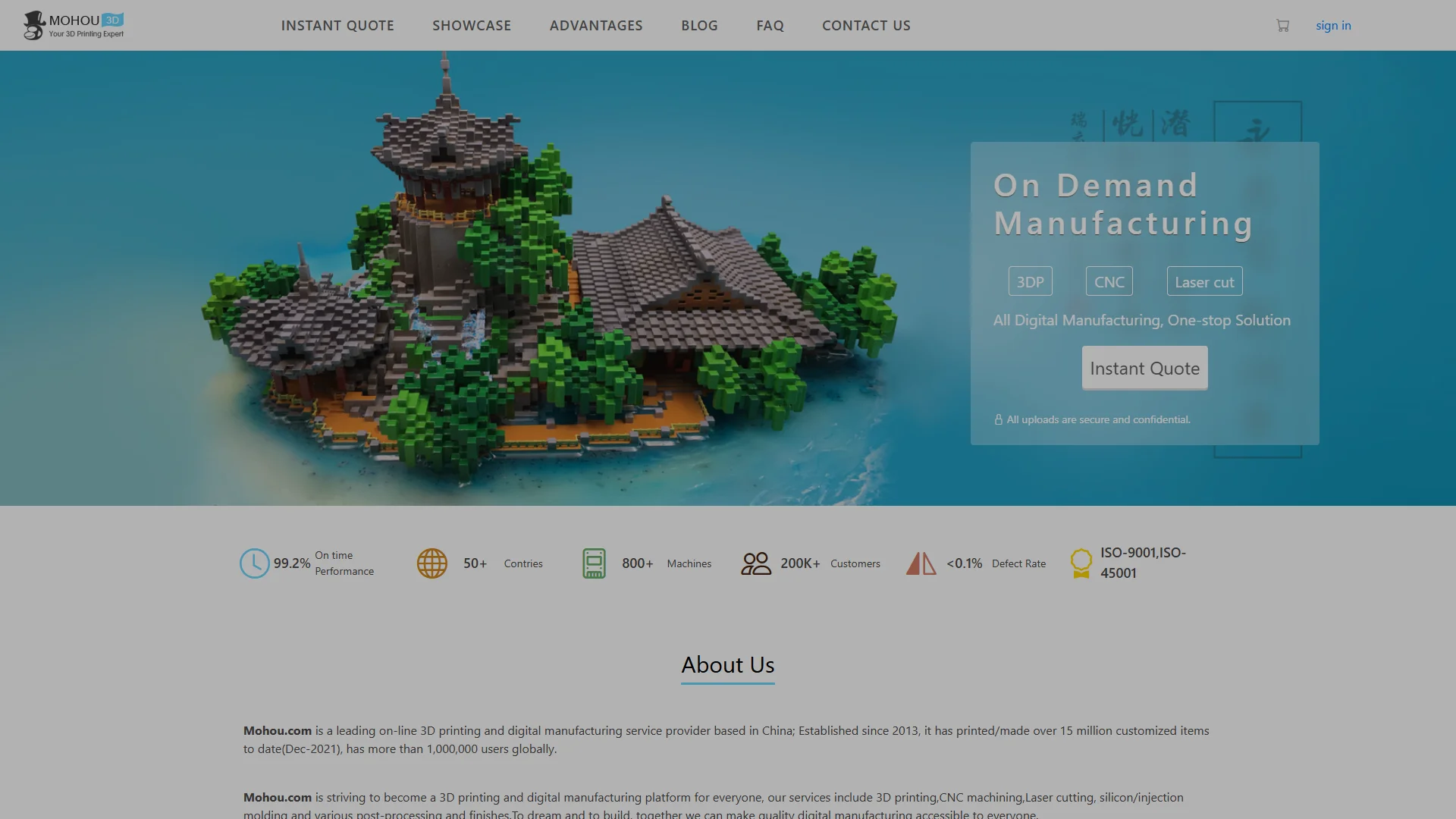
Mohou is described in the supplied dossier as an online 3D printing and digital manufacturing service provider based in China. The dossier states that the company has operated since 2013 and has printed or made more than 15 million customized items. It also describes Mohou as serving customized orders and seeking to make digital manufacturing accessible.
Products, Materials, and Capabilities
The documented service scope includes 3D printing, CNC machining, laser cutting, silicone molding, injection molding, and various post-processing and finishing options. The dossier states that customers can choose from more than 50 materials, including examples such as PEEK, PC, transparent materials, and silver. It also references SLS and SLM production descriptions, including applications involving strength, impact resistance, chemical resistance, heat resistance, and industrial-grade parts.
Market and Business Scope
Mohou’s evidence points to an online ordering model serving international customers. The supplied research states that the company had more than 1,000,000 global users as of December 2021 and cites a delivery estimate of two to five days to worldwide destinations. The dossier also mentions support from in-house 3D designers, copyright retention for customer designs, and a free remake or refund when an error is attributable to the company.
Pros / Key Features
- Broad documented manufacturing scope beyond 3D printing alone.
- More than 50 material options stated in the supplied research.
- Design assistance for customers who need help preparing a project.
- Support for complex designs, sculptures, concept models, and industrial prototypes.
- Claims concerning quick lead times, global delivery, and remedies for company-caused faults should be confirmed for each order.
Use Cases / Best For
Mohou is a strong fit for customers seeking customized prototypes, concept models, complex decorative parts, industrial components, or a combination of additive and conventional digital manufacturing. Buyers should still compare material-specific pricing, surface-finish expectations, tolerances, shipping terms, and inspection procedures before placing a production order.
3. IN3DTEC
Overview
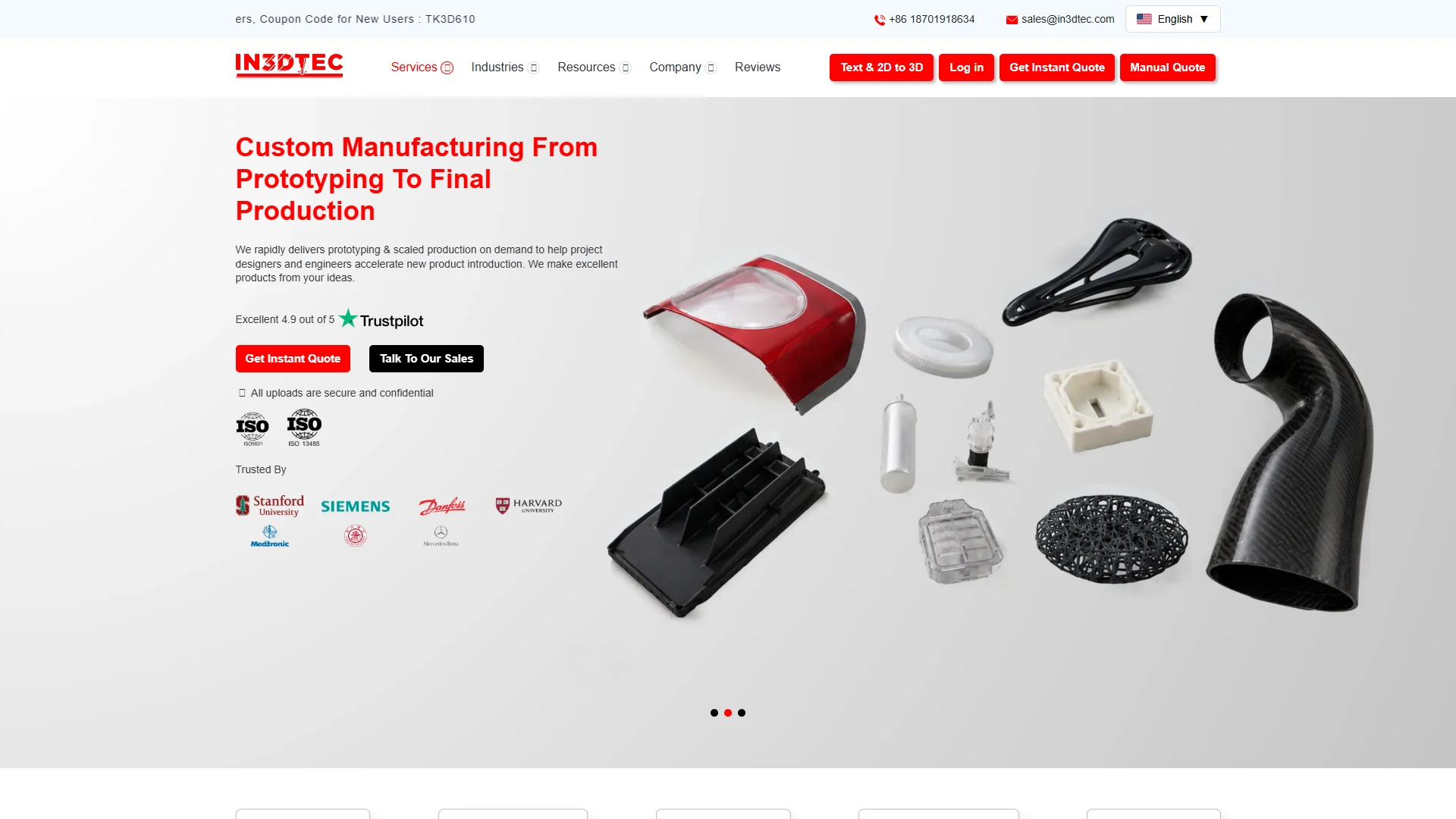
IN3DTEC is included as a China-related 3D-printing supplier candidate, but the supplied research dossier does not clearly establish its founding history, location, positioning, customer segments, manufacturing methods, materials, finishing capabilities, certifications, or delivery terms. The official website is therefore the appropriate source for confirming the company’s current service scope.
Products and Market Scope
No specific product categories or material portfolio are clearly documented in the available evidence. The research does identify online ordering as a sales channel and references a new-user coupon code, but this alone does not establish the range of services, production technologies, or commercial conditions. Prospective customers should ask for a current process list, material data, maximum part dimensions, quality-control documentation, and shipping information.
Pros / Key Features
- Maintains an official website for direct service verification.
- Online ordering is referenced in the supplied research.
- Publicly available dossier evidence is limited, so capabilities should not be assumed.
Use Cases / Best For
IN3DTEC is best for buyers prepared to conduct direct supplier qualification before ordering. It may be considered for prototype or production work after the company confirms applicable technologies, materials, tolerances, finishing, inspection, minimum quantities, and delivery arrangements.
4. Unionfab
Overview
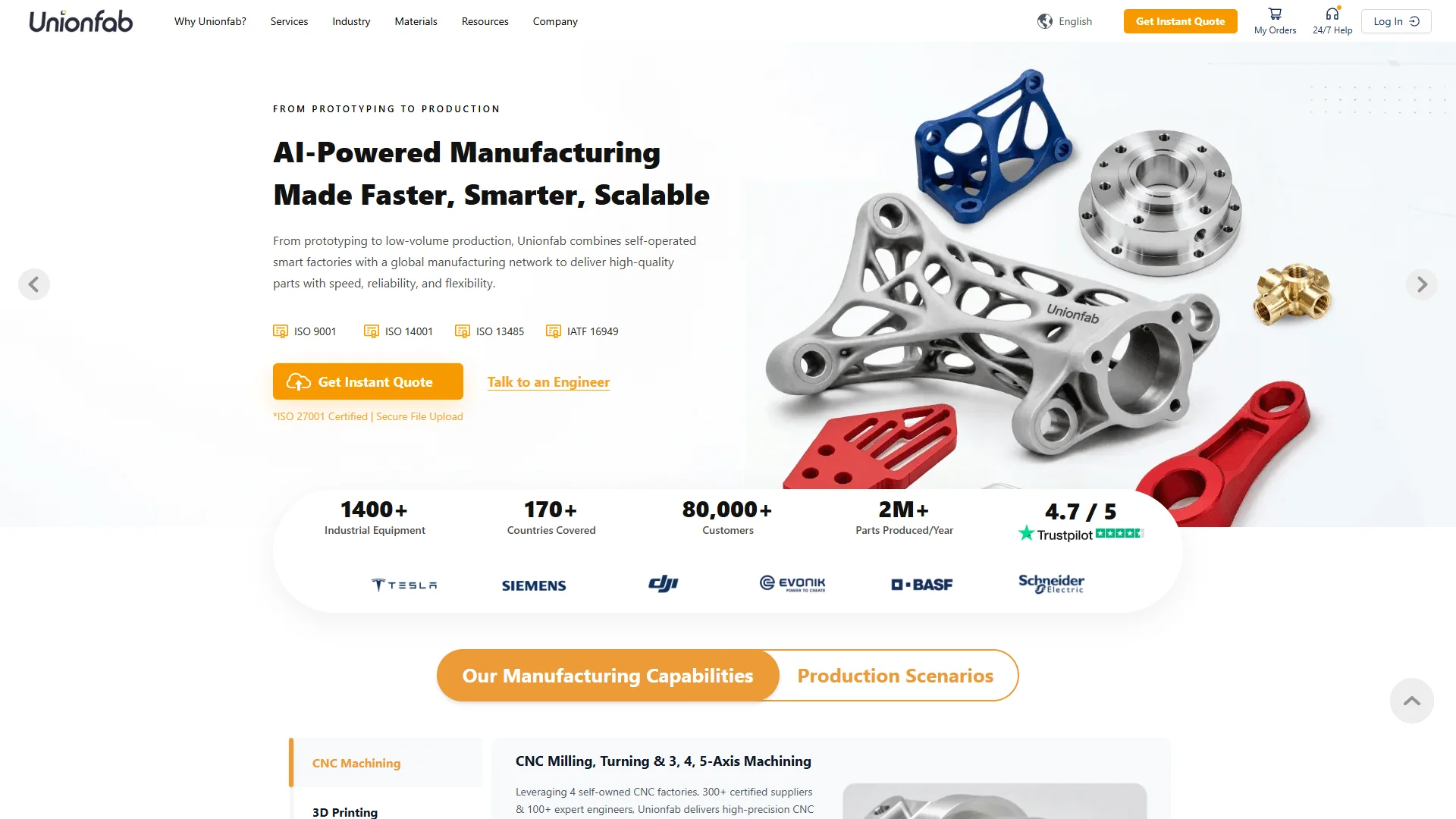
Unionfab is positioned in the supplied research as a custom on-demand manufacturing provider. The documented page title, “Custom On-Demand Manufacturing | 3D Printing & CNC | Unionfab,” supports a comparison angle that combines additive manufacturing with CNC production rather than treating 3D printing as the only route.
Products and Manufacturing Scope
The available evidence identifies 3D printing and CNC as core service categories. It does not clearly document specific printing processes, materials, finishing methods, tolerances, certifications, minimum order quantities, or delivery regions. Those details are important when deciding whether a particular part should be printed or machined and should be requested from Unionfab for the relevant design.
Pros / Key Features
- Clear positioning around custom, on-demand manufacturing.
- Combines 3D printing and CNC in the documented service description.
- Potentially useful when a buyer wants to compare additive and subtractive production routes.
- Specific material, quality, inspection, and delivery information requires confirmation.
Use Cases / Best For
Unionfab is best suited to businesses looking for custom manufacturing and evaluating whether a component is better produced through 3D printing or CNC. It may be relevant for prototypes, replacement parts, fixtures, and low-volume custom work, subject to confirmation of the exact capabilities required by the design.
5. Rapid.Tech 3D
Overview
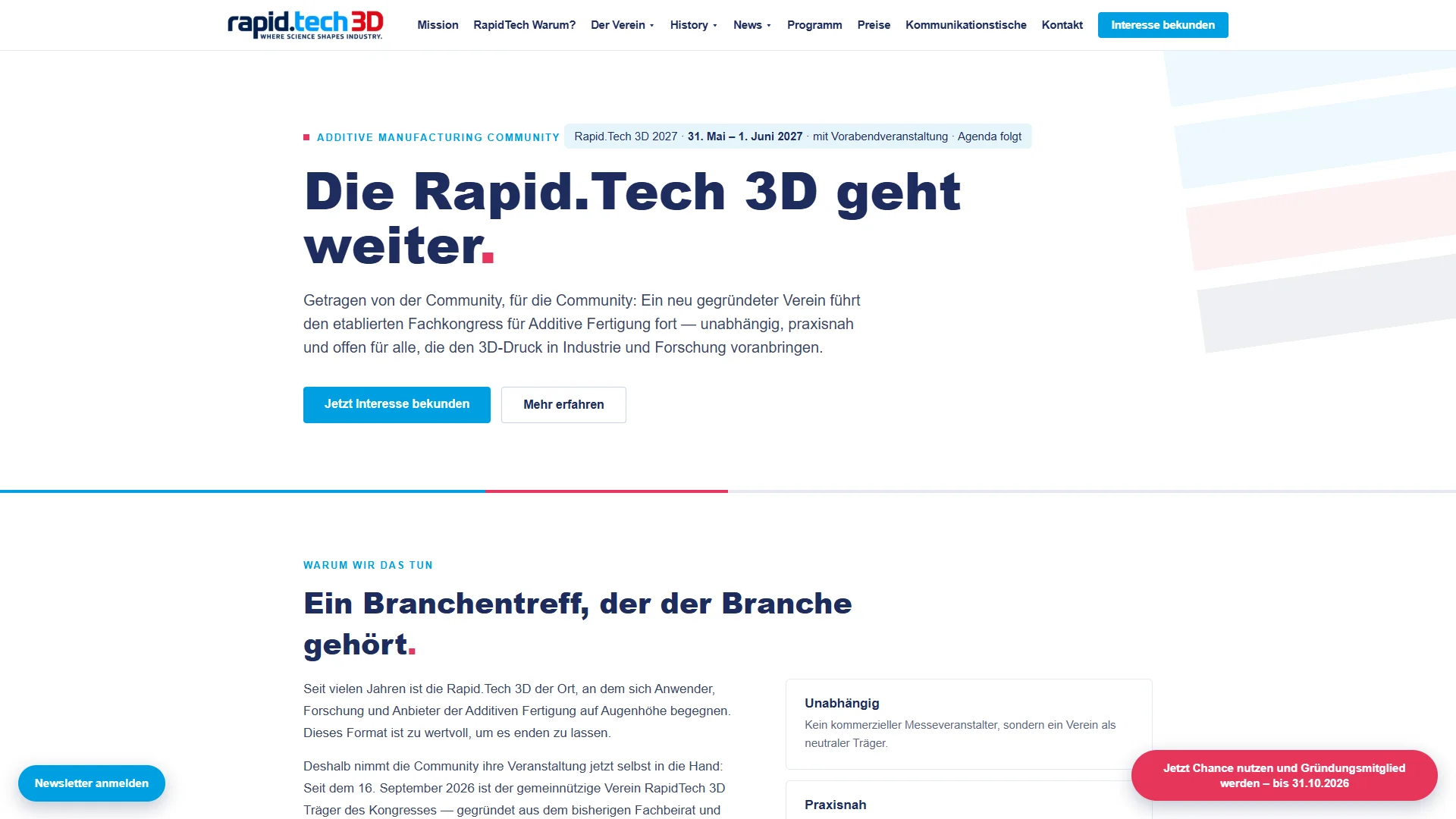
Rapid.Tech 3D is included in the supplied roster as an additive-manufacturing industry platform rather than a clearly documented China-based production service. The available research describes keynotes and presentations covering additive-manufacturing technologies, materials, and industrial applications. It also describes a communication-table format intended to support direct professional discussions.
Products, Materials, and Scope
The supplied evidence does not identify a direct print-on-demand catalogue, material pricing, production capacity, or fulfilment service. Its documented focus is knowledge exchange and industry communication. Buyers looking for a manufacturing supplier may therefore use Rapid.Tech 3D to learn about technologies or meet relevant industry participants, but should not assume that the event itself will manufacture a part.
Pros / Key Features
- Documented focus on additive-manufacturing technologies, materials, and industrial applications.
- Professional presentations and keynotes provide an industry-learning angle.
- Communication tables are intended to encourage focused technical discussions.
- Direct manufacturing services and China-specific fulfilment are not established by the supplied research.
Use Cases / Best For
Rapid.Tech 3D is best for technology scouting, professional networking, market education, and discovering potential additive-manufacturing partners. It is not the clearest choice for a buyer seeking a direct online quotation for printed parts unless a participating supplier separately provides that service.
How to Choose a 3D Printing Service in China
- Match the process to the part. Determine whether the design requires polymer printing, metal additive manufacturing, CNC machining, molding, or a combination of methods.
- Check material suitability. Review strength, heat resistance, chemical resistance, flexibility, appearance, regulatory requirements, and availability rather than choosing solely by price.
- Request technical limits. Confirm build volume, wall thickness, dimensional tolerance, minimum feature size, expected accuracy, and likely surface finish.
- Clarify finishing and inspection. Ask whether sanding, polishing, painting, plating, heat treatment, machining, dimensional inspection, or other post-processing is available.
- Compare total landed cost. Include setup charges, material costs, finishing, packaging, shipping, duties, taxes, and any remake or revision policy.
- Evaluate communication and intellectual-property terms. Confirm file handling, confidentiality, design ownership, revision support, and who is responsible for design-for-manufacturing changes.
- Validate quality before scaling. Start with a sample or pilot order, then assess consistency, packaging, documentation, and delivery performance before committing to larger quantities.
- Separate platforms from manufacturers. An industry event or sourcing platform can help identify suppliers, but its role may differ from that of a factory or online production service.
Final Verdict
TCT Asia ranks first as a strategic starting point for researching additive manufacturing, technology trends, and potential industry connections, although its direct production role must be confirmed. Mohou is the most clearly documented production-oriented option in the supplied material, with a broad digital-manufacturing scope, extensive stated material selection, and design-support indications. Unionfab is relevant to buyers comparing custom 3D printing with CNC. IN3DTEC requires more direct verification because the available public dossier provides limited capability information. Rapid.Tech 3D is better suited to technical learning and professional networking than to direct part procurement. The most suitable choice depends on whether the priority is supplier discovery, online manufacturing, process comparison, or industry knowledge.
FAQs
Are all five options direct 3D printing manufacturers?
No. Mohou and Unionfab are described with production-oriented capabilities in the supplied research. TCT Asia and Rapid.Tech 3D are better treated as industry or discovery platforms unless their official websites confirm direct manufacturing services. IN3DTEC requires additional verification.
What information should be included in a quotation request?
Include the 3D file format, part dimensions, quantity, intended application, material requirements, color, surface finish, tolerance, post-processing needs, delivery location, and deadline. Ask for shipping, inspection, remake, intellectual-property, and revision terms as well.
Is the cheapest Chinese 3D printing quote usually the best choice?
Not necessarily. A lower initial price may exclude finishing, inspection, packaging, shipping, duties, or design correction. Comparing the complete landed cost and requesting a representative sample generally gives a more useful basis for selection.