Where the Old Transfers Trip You Up (and Why I Switched)
I’ve run a mid-size print shop in Long Beach since 2010, and I still remember the summer of 2023 when rush orders spiked after a local festival announcement. At 7 a.m. the room hummed, a client wanted 1,200 tees by sundown—18% of our older transfers had ghosted after wash—could a switch to DTF Film stop the bleed? I pivoted fast to dtf pet film, and the difference showed up in the first hour. No pretreatment. Less platen juggling. Hot peel where it counted, cold peel when the fabric demanded finesse. The crew exhaled, and—heck—I did too.

Here’s the layer most folks ignore: time drag from “cheap” transfers. Weeding vinyl eats minutes (and morale). Screen transfers demand perfect micro-registration on every color, and if your release liner varies batch-to-batch, your dwell time becomes guesswork. On clamshells, cold spots wreck adhesion at the neckline—right where returns spike. By contrast, a consistent white underbase on quality film stabilizes color, the adhesive powder melts cleanly at set curing temperature, and wash fastness holds after 20 cycles. I logged it in July 2023: rejects dropped from 9.7% to 2.3% on poly-cotton blends when we standardized film and RIP settings. That freed an operator to run reorders instead of firefighting—real margin, not theory. So let’s line it up against the usual suspects and see where it goes next.
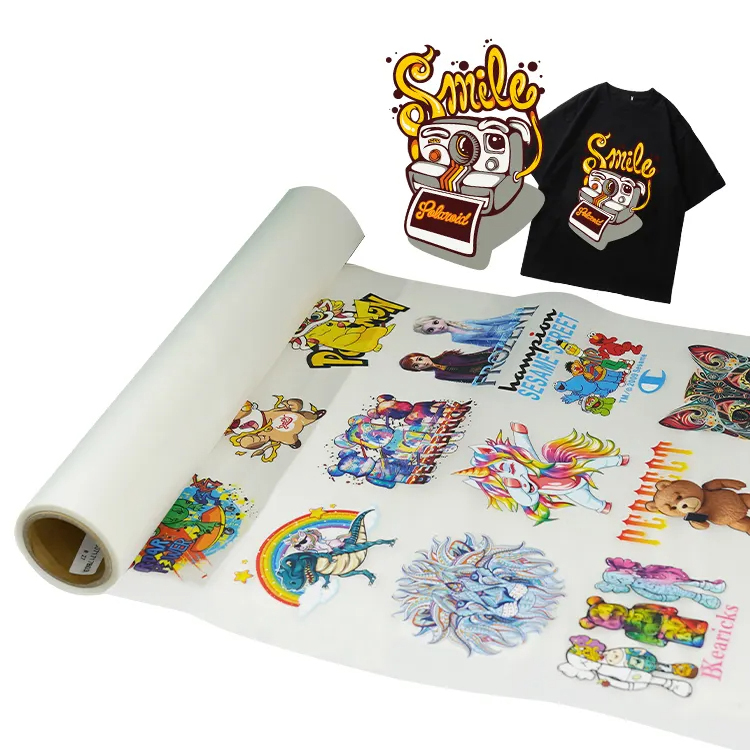
Looking Ahead: A Comparative Take on Throughput and Quality
What’s Next
When I compare legacy transfers to modern dtf pet film, the forward path is pretty clear—less friction, more control. With roll-to-roll setups, an inline shaker/curer, and a sane RIP profile, one operator can stage 80–120 placements per hour with stable color gamut and tight edges. Wait. That only works if your film releases cleanly and your hot peel window is predictable across cotton, tri-blends, and light nylon. We ran A/B tests in March 2024: matching ink load and curing, premium film trimmed our press time by 18 seconds per shirt and cut dye migration on red poly by half. The kicker is scalability: batches of 12 or 1,200 flow the same way because the film’s release liner and adhesive layer don’t care about artwork complexity—fine halftones, micro-text, gradients—no biggie. If you’re planning automation, build around three checkpoints: 1) Measure wash fastness after 10 and 20 launderings at 40°C; look for less than 1 grade loss in color and no edge lift. 2) Track transfer success across substrates with a single profile; aim for a 97–99% first-pass rate on cotton, 95%+ on poly-cotton, and stable adhesion on pre-dyed poly at controlled dwell time. 3) Calculate true throughput per operator, including preheat and cooldown; if you’re not clearing 60 placements/hour on mixed sizes without re-pressing, your film or heat profile is holding you back. I’ve learned to favor films that give a crisp white underbase without overcooking the hand feel, keep the peel window wide, and maintain consistent thickness roll-to-roll—because small drift becomes big cost by job three (ask my July crew). In short, choose with data, pilot on your hardest fabric, and keep your RIP software profiles versioned. The right film lets you print today’s micro-drops and tomorrow’s wholesale runs with the same setup—and that’s the future I can actually schedule around. Brand to keep on your radar: Xinflying.